WPC vs. Marine Plywood for Bangalore Interiors: The Architectural Comparison
Why Bengaluru's leading architects and modular interior studios are replacing traditional plywood with high-density engineered WPC boards (0.70 density) for kitchens, doors, and wet zones.
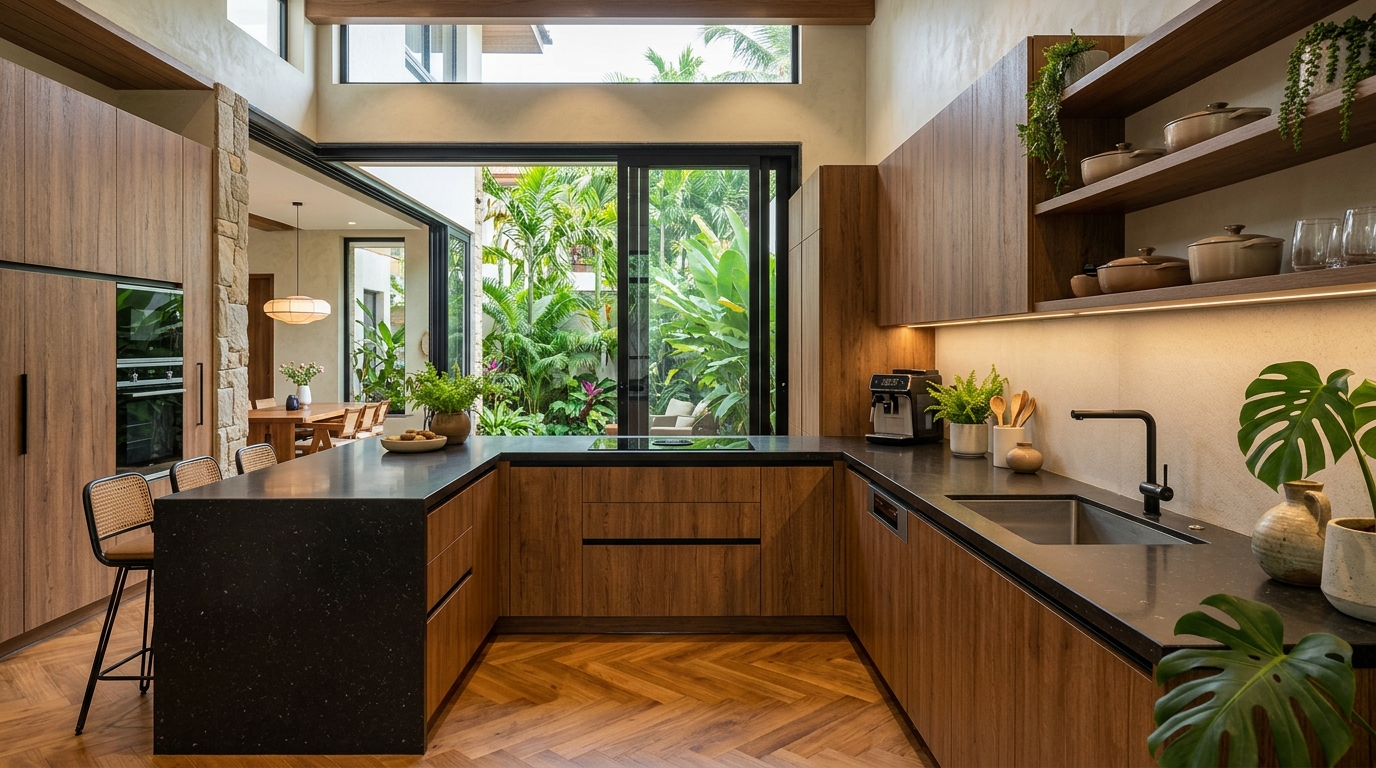
In Bengaluru's fast-evolving architectural landscape—from sprawling villas in Whitefield and Sarjapur to contemporary luxury apartments in Indiranagar and Koramangala—interior designers and modular kitchen manufacturers face a persistent challenge: moisture-induced material failure. For decades, commercial timber boards graded as Marine Plywood, BWP (Boiling Water Proof), or BWR (Boiling Water Resistant) were treated as the default standard. Yet, within 3 to 5 years of installation, countless homeowners experience the same frustrating issues: swollen cabinet bases under the kitchen sink, delaminating bathroom vanity doors, jamming door frames during the monsoon, and silent termite infestations.
The Chemistry of Failure in Traditional Plywood
To understand why plywood fails in wet zones, one must examine its microscopic structure. Plywood is composed of thin veneers of wood glued together under pressure using urea-formaldehyde or phenol-formaldehyde adhesives. Regardless of how well the exterior face is laminated or edge-banded, wood is naturally hygroscopic. It constantly breathes in atmospheric moisture. During Bengaluru's rainy months, continuous ambient humidity triggers hydrolytic degradation in the adhesive bonds. Once moisture penetrates the sub-sink carcass or bathroom partition, the wood fibres expand, the veneers separate (delamination), and structural rigidity collapses.
Furthermore, because timber contains cellulose—the primary food source for termites and wood-boring beetles—even chemically treated plywood eventually loses its chemical potency, leaving expensive custom cabinetry vulnerable to irreversible pest damage.
Enter High-Density WPC: Engineering Beyond Wood
Wood Plastic Composite (WPC) is not a surface coating; it is an engineered hybrid material. At Wallpex, our flagship WALLPEX ELITE board blends high-grade polymer resins with genuine natural wood fibres through advanced composite co-extrusion. The resulting board delivers the warmth, tactile workability, and density of natural timber while completely eliminating its vulnerabilities.
- 0.0% Water Absorption: Unlike plywood, Wallpex WPC boards do not absorb moisture even when completely submerged. They are 100% waterproof, making them immune to pipe leaks, floor washing, and high-humidity dampness.
- Complete Termite Immunity: Because the natural wood fibres are fully encapsulated in a synthetic polymer matrix, termites cannot digest or penetrate the material. Wallpex backs this performance with a structural Lifetime Warranty.
- Zero Formaldehyde (E0 Emission Standard): Conventional plywood continuously releases toxic formaldehyde fumes (off-gassing) for years inside closed bedrooms and living spaces. Wallpex composite boards are 100% lead-free and emit near-zero volatile organic compounds (VOCs), ensuring healthy indoor air quality for modern homes.
The Critical Role of Density: Why 0.70 g/cm³ Matters
One of the most common misconceptions among contractors and homeowners is that 'all WPC is the same.' In the Indian market, low-cost composite and cellular foam boards often flood retail counters with densities as low as 0.50 to 0.55 g/cm³. While lightweight, these low-density boards lack the structural core density required to hold heavy European concealed hinges and screws.
For high-load applications like modular kitchen base units carrying 20mm Italian marble or quartz countertops, high-density calibration is mandatory. WALLPEX ELITE is calibrated to an authentic 0.70 g/cm³ density. Thanks to its natural wood-fibre composite formulation, it provides superior screw-holding torque that matches and exceeds calibrated hardwood plywood, ensuring cabinet doors never sag or loosen over decades of daily use.
Primary Architectural Applications Across Bengaluru
1. Modular Kitchen Carcasses (The Wet-Zone Defense)
The sink module is the most failure-prone area in any kitchen. Minor plumbing drips or wet cleaning rags quickly turn plywood into a breeding ground for mould and swelling. Modular kitchen OEMs across Bangalore routinely specify WALLPEX ELITE for the sink unit, hob carcass, and skirting panels. While designers may choose high-gloss acrylic or veneer shutters on the front, an engineered composite carcass guarantees that the structural skeleton remains pristine for life.
2. 100% Waterproof Solid Doors & Bathroom Chaukhats
Bathroom doors take continuous direct water splashes and heavy condensation. Traditional flush doors with timber internal battens inevitably warp and jam against the frame within a few seasons. Carpenters and door fabricators use 17mm and 18mm Wallpex boards as solid-core door slabs that can be CNC grooved, painted with PU polish, or cladded with decorative laminates. The result is a solid, elegant door that never expands, sticks, or rots.
3. Modern Architectural Fluted Panels & CNC Jaali
A major design trend across Bangalore interiors is the use of fluted feature walls behind living room TV consoles and bedroom headboards. Because Wallpex boards are manufactured with genuine wood fibres without artificial dye masking, they machine cleanly on CNC routers without the fuzzy edges or splintering common in low-density PVC foam. Designers can route bespoke architectural patterns and apply duco or PU finishes seamlessly.
4. Ready-to-Install Wardrobe Partitions with WALLPEX 3CORE
For large-scale wardrobe tall-units and structural partitions where installation speed and cost-efficiency are critical, WALLPEX 3CORE offers an innovative solution. Engineered with an advanced 3-layer composite core and factory-calibrated glossy white outer skins, it eliminates the labour and cost of painting or pressing laminates on internal carcass surfaces—allowing carpenters to simply cut, screw, and fix.
Summary: The Specification Verdict
While commercial plywood remains widespread due to legacy carpentry habits, Bangalore’s discerning architects, interior designers, and homeowners increasingly recognize that replacing water-damaged plywood cabinetry is far more expensive than specifying the right material from day one. By choosing high-density composite engineering from Wallpex, you invest in permanent structural confidence, certified environmental safety, and true lifetime durability.